Navarre Corp.’s FUNimation Ent. has acquired home video, broadcast and theatrical rights to the feature film Robotech: The Shadow Chronicles from Harmony Gold. The new flick is a continuation of the popular 1980s series, which left fans with a cliffhanger nore than 20 years ago.
“Robotech is the series that introduced an entire generation to anime," says Gen Fukunaga, president and CEO of FUNimation. "FUNimation is very excited to be part of the team that will bring expectant fans the ending they have been waiting for in Robotech: The Shadow Chronicles."
Robotech: The Shadow Chronicles is directed by Tommy Yune, who worked on visual effects for the original TV series and produced the video games Robotech: Battlecry, Robotech: The Macross Saga and Robotech: Invasion. In the film, Scott Bernard, Vince Grant and a host of other characters from the series fight to end a decades-long struggle against an enigmatic alien race known as the Invid. However, the mysterious disappearance of the legendary Admiral Hunter will unfold in a treacherous mystery that could tear apart our young heroes and threaten their very survival. Mark Hamill (Star Wars, Batman: Mask of the Phantasm) and Chase Masterson (Star Trek: Deep Space Nine, Manticore) lend their voices to the production.
According to FUNimation, Robotech: The Shadow Chronicles will give the franchise an updated the look by incorporating CG graphics with the classic anime style. FUNimation plans to release the movie on DVD on Nov. 21.
Source
Friday, August 4


Wednesday, August 2
Ghost in the Shell: Stand Alone Complex 1st Gig Review

Story & Characters
This is my 3rd review on the franchise, namely Ghost in the Shell: Stand Alone Complex, animated TV series started in 2002 and end its run in 2003.
Set in not too far dsytopian future of Japan, as outlined in politically heavy manga series by famous artist Masamune Shirow where technology has reach the stage where full replacement of human body is made possible by cyborg technology and more remarkably, the ability to retain human mind and consciousness in artificial brain which also can be hooked to cyberspace, directly via a port at back of the neck.
This anime occurs in parallel story within the universe, this series assumed Major Kusanagi is still around as separate and unique person working for Public Security no 9, an organization which is para-military and specializes within legal definition of permissible law, all in interest of national security of Japan. Led by bureaucrat master and stern moralist Aramaki, it is a micro organization which is meant to be backhand option for Japan leadership to get results semi legally or below that.
The focus here is on seemingly unconnected issue of corruption in highest echelon of government and civil disobedience campaign by a super hacker known as Laughing Man because he uses a smiley as disguise while conveying his message, remote hacking brains of high level officials in order to do so. All episodes are meant to be unified into single encompassing story but yet able to stand on its own hence the secondary title Stand Alone Complex. Unlike the lonely Puppet Master 2501 or mercenary Kim, Laughing Man is driven by justice and he is morally outraged by public complicity regarding a disease caused by high technology usage called the Murai Syndrome.
Section 9 got a whiff of him and at first decided to hunt him down but as their investigation gets deeper, they come close to gnawing corruption within the government. As the time runs out for the hacker, the government and even seemingly invincible Section 9, will justice prevails? Or condemned to be buried in official secrecy with Section 9 and Laughing Man as collateral?
Characters is basically the same from the movie adaptation, bisexually headstrong Major, smug but bitter Bateau or Batou, steadfast, idealistic Togusa and fatherly Aramaki plus host of minor characters like the mysterious sniper and a wise hacker. Not forgetting too, as clutch of comic relief comes in 9 AI mini tanks known collectively as Tachikoma. Their insatiable and childlike curiousity serves as amusement but has some very thought provoking dialogues to reflect their growing development of acquiring sense of self. However their development can cause them to be liability as primary weapon system as outlined in one of the important episode later on. Perhaps this is a way the creators of this series trying to insert humor since the humanoids in the narrative is too grim and cynical to be genuinely funny in nature.
Rating
10 (excellent)

Art
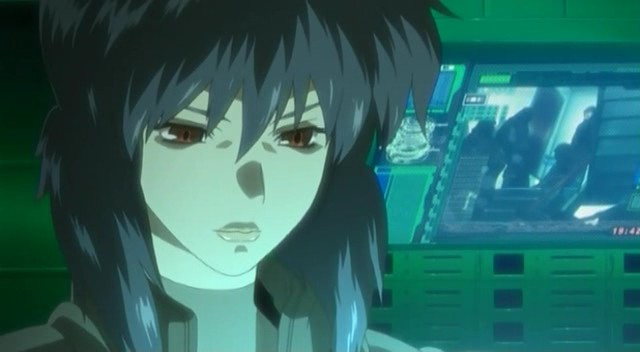
Visually not as stunning and poetic as the 2 movies but nevertheless considering for TV series it is on high production value. Shown bi monthly for purposes of retaining consistent quality, the art is smooth, pleasing yet dark enough to induce the mood suitable for the story in progress. However for those who preferred the movie art established by first Ghost in the Shell movie in 1995, they might find the character design is too toned down and not strong enough to convey sense of artificiality as they are androids. Background is well done and there is little or no looping animation which reflects the high quality production.
Machinery is detailed enough, which highlighted by the AI tanks and tilt rotor primary dropship used by Section 9. Computer animation is used liberally but not to the point of overwhelming the traditional cell art like common issue with series from GONZO studio.
But in all fairness, the art in the series is better than most anime TV series out there and it is certainly not too shabby even compared to its movie cousin vis- a -vis.
Rating
8 (good)
Sound
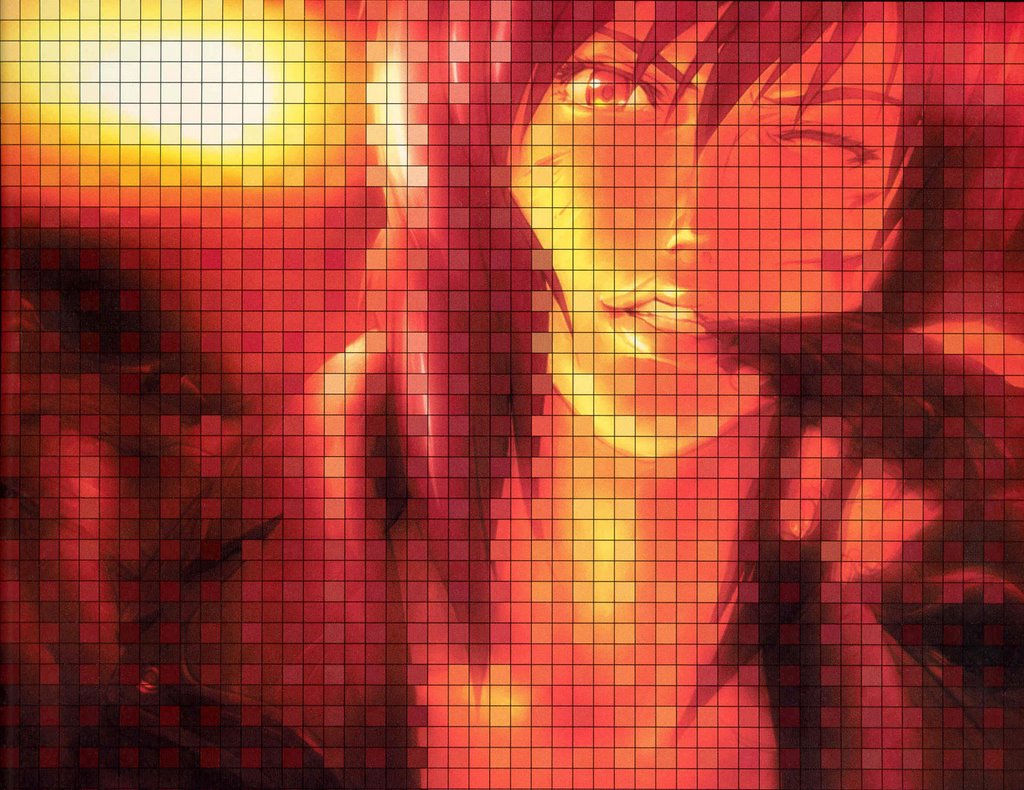
The soundtrack of the series fits the mood of the narrative power. Opening song, Inner Universe is very unique as it is sang in Russian which I felt appropriate as Russian language is very melodious and beautiful plus it is an entirely foreign tongue, reinforces the alienation of self from other which is the series underlying concept.
The OST is subtle, not too intrusive on the story progress. However, some scenes can benefit from stronger presence of background music for transitional from one scene to another scene. The ending theme is not bad, but there is nothing to shout about it.
Voice acting in Japanese is very professional, generally reflected the character well. Something about the voice acting of Japanese separates them from US or any other country is their level of training and dedication to make the character sound right. In this series, it is even more so since it is a serious series to begin with. A normal cutesy voice has no place in this series for humans but Tachikoma relish with cutesy voice somehow did not look out of place since they are not humans. Interesting dichotomy yes?
Rating
7 (above average)
Presentation
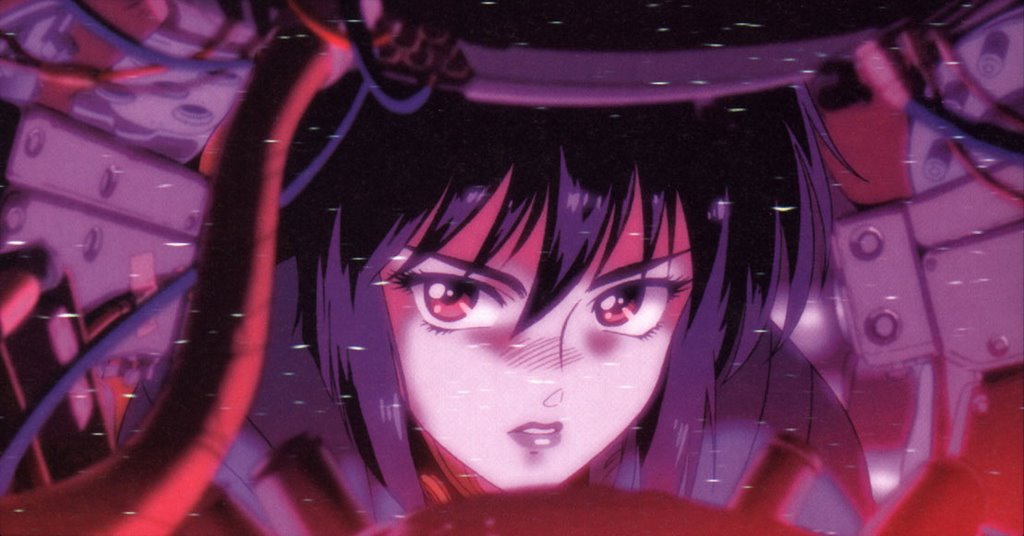
Originally meant to be 26 episode anime series, the ratings is strong enough for investors to plunk in more money for second series, namely Ghost in the Shell: Stand Alone Complex Second Gig which just recently concluded its run in Japanese TV. This speaks volume about popularity of the franchise and this series did not disappoint at all. Delightfully deep and serious for discerning viewer, it has enough multilayered symbolisms to chew on and digest. Sophisticated and generally impatient for those who did not grasp it, the anime rushes into story while beguiling more intelligent viewer with well spun tale.
The story drew heavily from real life examples of Japanese symbiotic political economy corruption tie in like Recruit Scandal and Toshiba illegal technology transfer. Political activist like Laughing Man and bureaucrat incognito force like Section 9 is foil to this malaise that is affecting the Japanese society where corruption is so deep rooted that sometimes it looks impossible to be taken down. The story explored this theme and tries bravely to answer in acceptable manner. Sometimes the morality is blurred between pragmatic necessity and social justice. Perhaps this is real intention of the series in the first place.
Some episodes introducing characters in play and some episodes are in continuity, leading to the ultimate story arc, which is resolution of Laughing Man mystery. As mentioned earlier, each episode meant to be single story on its own except for the last few. The humor factor is an exclusive domain of the Tachikomas AI tanks with some penetrating insight into things with quotes like "I think God is zero!"
The pacing is much more fluid and quicker than the movies which are criticized as being too plodding and too infused with personal philosophy which alienated the audience. As secondary title suggested, it is meant to be concluded in one episode as much as possible thus, expanding more on the universe. For example we now knew that 2 World Wars has erupted and USA is a democratic imperialist like ancient Athens, which helps to shape as to why the political decision is as it is. Shirow's original vision is decidedly political and the series paid homage to it in spades.
All in all, this is one exceptional series of the great franchise and I will not hesitate to acquire the DVDs of it.
Rating
9 (very good)
Popularity of classes in cartooning and anime reflect a national interest in the genre
Tuesday, August 1, 2006
By JUDITH W. WINNE
Courier-Post Staff
In a Merchantville studio off Maple Avenue, half a dozen young students huddle over stick figures they hope to bring to life.
"In time, you add shapes of the character," said Mike Gorostiza, an instructor of the cartooning and anime class at Parsons Center for the Arts. "You articulate, and add eyes and nose and sometimes you put in expressions."
Students sketch circles, where hands, feet, joints and muscles will eventually go. Sharp lines form trapezoids, an upper one for the torso, a lower one for the trunk. It's a blueprint.
"Remember, don't make these stick figures too dark," advised Gorostiza, who lives in Delran. "They're eventually going to be erased. They're a template for the character."
In just a few days, students will create pictures and stories, two-frame cartoons showing a moment in time: a man falling, plop!, in the water, a couple under an umbrella hit by lightning -- and then warmed by a burst of sunlight.
Local interest in cartooning reflects a national trend -- comics as a hot property.
Like a ravenous superhero, cartoons, comic books and animation have taken a bite out of the cultural landscape.
Children grow up tuned into The Cartoon Network, watching Spider-man and Superman at the multiplex and playing video games starring animated figures.
Recently, USA Today reported on a new DVD, The Transformers: The Movie 20th Anniversary Special Edition. Also new is Who Wants To Be A Superhero, a SciFi reality show in which participants dress up in costumes and try to exhibit superhero character traits, like courage. The winner gets to be featured in a Stan Lee comic book.
The article can be seen here.
By JUDITH W. WINNE
Courier-Post Staff
In a Merchantville studio off Maple Avenue, half a dozen young students huddle over stick figures they hope to bring to life.
"In time, you add shapes of the character," said Mike Gorostiza, an instructor of the cartooning and anime class at Parsons Center for the Arts. "You articulate, and add eyes and nose and sometimes you put in expressions."
Students sketch circles, where hands, feet, joints and muscles will eventually go. Sharp lines form trapezoids, an upper one for the torso, a lower one for the trunk. It's a blueprint.
"Remember, don't make these stick figures too dark," advised Gorostiza, who lives in Delran. "They're eventually going to be erased. They're a template for the character."
In just a few days, students will create pictures and stories, two-frame cartoons showing a moment in time: a man falling, plop!, in the water, a couple under an umbrella hit by lightning -- and then warmed by a burst of sunlight.
Local interest in cartooning reflects a national trend -- comics as a hot property.
Like a ravenous superhero, cartoons, comic books and animation have taken a bite out of the cultural landscape.
Children grow up tuned into The Cartoon Network, watching Spider-man and Superman at the multiplex and playing video games starring animated figures.
Recently, USA Today reported on a new DVD, The Transformers: The Movie 20th Anniversary Special Edition. Also new is Who Wants To Be A Superhero, a SciFi reality show in which participants dress up in costumes and try to exhibit superhero character traits, like courage. The winner gets to be featured in a Stan Lee comic book.
The article can be seen here.
Monday, July 31
Discovering Japan: Anime and Learning Japanese Culture
Annie Manion
A Master’s Thesis Submitted to East Asian Studies Center
University of Southern California
Introduction
I recently took a course in anthropology called “Japanese Popular Culture”.
Knowing from my research that there are many students at USC interested in anime, Japanese film, videogames and manga, I expected the class to be full of otaku . I was surprised to find the class was comprised mostly of people who knew very little about Japan, but for some reason were attracted to some aspect of Japanese pop culture, whether it was fashion, music, or as was most often the case, anime. They were not there to learn more about something they already had a passion for, as the otaku I expected to see in the class, but rather to learn more about something they knew hardly anything about.
Since the success of the animated series Pokemon in the late nineties, Japanese animation has been enjoying greater popularity and recognition in America. Known increasingly by the Japanese term “anime”, Japanese animation is gaining recognition as a medium that appeals to children and young people. Anime has had an undeniable effect on American popular culture.
For example, many children’s cartoons, such as The Powerpuff Girls and Kim Possible have begun to use an anime copycat style, “anime looks [were] leaping from the screen” at last fall’s fashion runways , and Hollywood blockbusters either use animated scenes directly (Kill Bill Vol. 1) or borrow imagery from anime (The Matrix Trilogy).
Though the effect anime is having on the visual style of American entertainment and fashion is easy to see, the implication of anime’s growing popularity for its country of origin, Japan, are much less clear. In the following discussion, I will report my findings on the basis of a poll, and take a closer look at the role anime plays in stimulating interest in Japan, and the ways in which interest in anime and Japanese popular culture are closely related to an interest in Japan.
It is in fact difficult to tease the two apart from each other, since it is impossible to participate in anime fan culture, except at the very shallowest level, and not be exposed to other forms of Japanese popular culture and traditional Japanese culture, and thereby be encouraged to explore them further. Anime and its relationship to interest in Japan are useful to consider in the context of teaching and learning about Japan. At the very least, one would think that a medium as easy
The rest of article is here.
A Master’s Thesis Submitted to East Asian Studies Center
University of Southern California
Introduction
I recently took a course in anthropology called “Japanese Popular Culture”.
Knowing from my research that there are many students at USC interested in anime, Japanese film, videogames and manga, I expected the class to be full of otaku . I was surprised to find the class was comprised mostly of people who knew very little about Japan, but for some reason were attracted to some aspect of Japanese pop culture, whether it was fashion, music, or as was most often the case, anime. They were not there to learn more about something they already had a passion for, as the otaku I expected to see in the class, but rather to learn more about something they knew hardly anything about.
Since the success of the animated series Pokemon in the late nineties, Japanese animation has been enjoying greater popularity and recognition in America. Known increasingly by the Japanese term “anime”, Japanese animation is gaining recognition as a medium that appeals to children and young people. Anime has had an undeniable effect on American popular culture.
For example, many children’s cartoons, such as The Powerpuff Girls and Kim Possible have begun to use an anime copycat style, “anime looks [were] leaping from the screen” at last fall’s fashion runways , and Hollywood blockbusters either use animated scenes directly (Kill Bill Vol. 1) or borrow imagery from anime (The Matrix Trilogy).
Though the effect anime is having on the visual style of American entertainment and fashion is easy to see, the implication of anime’s growing popularity for its country of origin, Japan, are much less clear. In the following discussion, I will report my findings on the basis of a poll, and take a closer look at the role anime plays in stimulating interest in Japan, and the ways in which interest in anime and Japanese popular culture are closely related to an interest in Japan.
It is in fact difficult to tease the two apart from each other, since it is impossible to participate in anime fan culture, except at the very shallowest level, and not be exposed to other forms of Japanese popular culture and traditional Japanese culture, and thereby be encouraged to explore them further. Anime and its relationship to interest in Japan are useful to consider in the context of teaching and learning about Japan. At the very least, one would think that a medium as easy
The rest of article is here.
Ready to Explode: Exploring the Cyberculture and Cyberfear of Japan in Anime
by Joseph Babcock
“It's the age of destruction,
In a world of corruption
It's the age of destruction
And they hand us oblivion.”1
-Billy Idol, Neuromancer
“The end of the world was only the beginning.”2
-Akira, 2001 Poster
Introduction: Society, Cyberpunk, and Akira
Japan, circa 1984: the Murai Jun group at the Tokyo Institute of Technology establishes the Japan University Network (JUNET), a computer system linking the mainframes of several universities.3 Japanese society witnessed many such advances in information technology during the 1980s, innovations which promised to greatly accelerate the flow of data and to replace manual labor with automated production.4 One scholar at the time predicted that “the impact of informisation [sic] on society as a whole will be as extensive as that of the industrial revolution.”5
Similar technological developments occurred worldwide during the eighties, as the foundations of the Internet sprang into being. In response, the science-fiction community began to examine the impact that this “computerization” might have on society, creating the Cyberpunk genre. Ironically, the establishment of JUNET coincided with the American publication of William Gibson's seminal Cyberpunk novel Neuromancer (1984), a brooding vision of an “informatized” society. In Japan, the themes explored by Gibson were echoed in many animated pictures, such as Katsuhiro Otomo's 1988 epic Akira. Set in the dark world of 2019 Neo-Tokyo, the film depicts a near-future cyberculture.
In most aspects Akira is far from subtle; boasting vivid imagery and an evocative musical score, it is a dramatic sensory experience. It is through symbolism and metaphor, however, that the themes of the film are articulated. These subtle elements reveal the anxieties surrounding the evolution of information networks in 1980s Japan, fears which are the focus of this paper. In this analysis, I will address two primary themes. One is the importance of information freedom, which is reflected in the conflict between Neo-Tokyo's corrupt government and a rebel opposition group. The second is the threat of information technology to the human form, which is represented by physical transformation in Akira.
While the portrayal of information technology in Akira demonstrates historical trends in public opinion, it also highlights the development of such sentiments over time. Like the computer industry, the Japanese Cyberpunk genre is a changing entity. A secondary purpose of this essay is to address thematic developments in the genre, as reflected in more recent films such as Mamoru Oshii's Ghost in the Shell (1996).
The Information Society: A Corporate Vision of Utopia
Beginning in the 1960s, Japanese policymakers predicted that computer-based technologies would revolutionize the nation's existing economic and social structures.6 This future Japan, in which information would be freely transmitted through a digital network, was described as an “information society” by Professor Hayashi Yujiro of the Tokyo Institute of Technology7. In Beyond Computopia (1988), Tessa Morris-Suzuki argues that this “informatised [sic]” society represents a “technocrats' Utopia, a public justification for the policies desired by economically powerful groups.”8 At the time, these groups were the zaibatsu, vertical hierarchies comprised of multiple corporations - mega-corporations of a sort - which rose to dominate the Japanese economy in the wake of World War II.9
Many Japanese citizens worried that the zaibatsu would become further empowered by this new society. Anti-establishment groups claimed that an “information society” would in actuality be a “controlled society”10 dominated by large corporations.11 The primary fear regarding this system, according to Morris-Suzuki, was that an increased freedom of information would allow these corporations to compile detailed “dossiers” 12 about their potential customers - with or without the knowledge of Japan's citizens. The “information society” was seen as a means to control knowledge, not liberate it. The flow of data would move in one direction, towards the zaibatsu. Indeed, Morris-Suzuki argues that the information society was but a “vast mechanism for converting the knowledge created by society into a source of corporate profits.”13 The control of information through technology became a form of power, a notion which, as I will argue, appears in Akira.
Given the massive influence of several Japanese corporations in the 1980s international market, such as the Nintendo company14, it seems small wonder that foreigners also imagined a future of information-brokering Japanese zaibatsu. This impact is clear in the opening to Neuromancer, which Gibson sets in the “Night City”15 underground of urban Chiba. The tensions surrounding the “computerization” of Japanese society in the eighties are mirrored in the work of Gibson and other Cyberpunk authors. Like Japan's citizens, the protagonists of the Cyberpunk world desire freedom and security of information, information which has been exploited by corrupt conglomerates. While Japan was not the only society undergoing “computerization” during the eighties, it held an important position at the head of this technological evolution.
The rest of article is here.
Extremely fascinating article for anime sci fi lovers.
“It's the age of destruction,
In a world of corruption
It's the age of destruction
And they hand us oblivion.”1
-Billy Idol, Neuromancer
“The end of the world was only the beginning.”2
-Akira, 2001 Poster
Introduction: Society, Cyberpunk, and Akira
Japan, circa 1984: the Murai Jun group at the Tokyo Institute of Technology establishes the Japan University Network (JUNET), a computer system linking the mainframes of several universities.3 Japanese society witnessed many such advances in information technology during the 1980s, innovations which promised to greatly accelerate the flow of data and to replace manual labor with automated production.4 One scholar at the time predicted that “the impact of informisation [sic] on society as a whole will be as extensive as that of the industrial revolution.”5
Similar technological developments occurred worldwide during the eighties, as the foundations of the Internet sprang into being. In response, the science-fiction community began to examine the impact that this “computerization” might have on society, creating the Cyberpunk genre. Ironically, the establishment of JUNET coincided with the American publication of William Gibson's seminal Cyberpunk novel Neuromancer (1984), a brooding vision of an “informatized” society. In Japan, the themes explored by Gibson were echoed in many animated pictures, such as Katsuhiro Otomo's 1988 epic Akira. Set in the dark world of 2019 Neo-Tokyo, the film depicts a near-future cyberculture.
In most aspects Akira is far from subtle; boasting vivid imagery and an evocative musical score, it is a dramatic sensory experience. It is through symbolism and metaphor, however, that the themes of the film are articulated. These subtle elements reveal the anxieties surrounding the evolution of information networks in 1980s Japan, fears which are the focus of this paper. In this analysis, I will address two primary themes. One is the importance of information freedom, which is reflected in the conflict between Neo-Tokyo's corrupt government and a rebel opposition group. The second is the threat of information technology to the human form, which is represented by physical transformation in Akira.
While the portrayal of information technology in Akira demonstrates historical trends in public opinion, it also highlights the development of such sentiments over time. Like the computer industry, the Japanese Cyberpunk genre is a changing entity. A secondary purpose of this essay is to address thematic developments in the genre, as reflected in more recent films such as Mamoru Oshii's Ghost in the Shell (1996).
The Information Society: A Corporate Vision of Utopia
Beginning in the 1960s, Japanese policymakers predicted that computer-based technologies would revolutionize the nation's existing economic and social structures.6 This future Japan, in which information would be freely transmitted through a digital network, was described as an “information society” by Professor Hayashi Yujiro of the Tokyo Institute of Technology7. In Beyond Computopia (1988), Tessa Morris-Suzuki argues that this “informatised [sic]” society represents a “technocrats' Utopia, a public justification for the policies desired by economically powerful groups.”8 At the time, these groups were the zaibatsu, vertical hierarchies comprised of multiple corporations - mega-corporations of a sort - which rose to dominate the Japanese economy in the wake of World War II.9
Many Japanese citizens worried that the zaibatsu would become further empowered by this new society. Anti-establishment groups claimed that an “information society” would in actuality be a “controlled society”10 dominated by large corporations.11 The primary fear regarding this system, according to Morris-Suzuki, was that an increased freedom of information would allow these corporations to compile detailed “dossiers” 12 about their potential customers - with or without the knowledge of Japan's citizens. The “information society” was seen as a means to control knowledge, not liberate it. The flow of data would move in one direction, towards the zaibatsu. Indeed, Morris-Suzuki argues that the information society was but a “vast mechanism for converting the knowledge created by society into a source of corporate profits.”13 The control of information through technology became a form of power, a notion which, as I will argue, appears in Akira.
Given the massive influence of several Japanese corporations in the 1980s international market, such as the Nintendo company14, it seems small wonder that foreigners also imagined a future of information-brokering Japanese zaibatsu. This impact is clear in the opening to Neuromancer, which Gibson sets in the “Night City”15 underground of urban Chiba. The tensions surrounding the “computerization” of Japanese society in the eighties are mirrored in the work of Gibson and other Cyberpunk authors. Like Japan's citizens, the protagonists of the Cyberpunk world desire freedom and security of information, information which has been exploited by corrupt conglomerates. While Japan was not the only society undergoing “computerization” during the eighties, it held an important position at the head of this technological evolution.
The rest of article is here.
Extremely fascinating article for anime sci fi lovers.
THE "JAPANIMATION" PHENOMENON"
March 6, 2003
Inspired by a team of two-dimensional heroes, at least one sector of the Japanese economy is booming. The legendary Astro Boy, Pokemon, Mazinger Z, Gundam, Sailor Moon, and Martian Successor Nadesico are just some of the names that have become familiar around the globe as Japanese cartoons, or anime, have cemented their place as the world's favorite form of animated entertainment. Now the national and some local governments are working with the anime industry to ensure that tomorrow's top animators receive the training and support they need to maintain this success.
Growing Mainstream Recognition
About 60% of all cartoons watched by people around the world today originate in Japan. Collectively dubbed "Japanimation," Japanese cartoons incorporate the broadest range of themes, from action heroes and space operas to martial arts, monster battles, school life, and fantasy worlds - with a cast of colorful characters to match.
The full-fledged export of anime titles began in the 1970s. Astro Boy gained popularity in Asia and the United States, while Mazinger Z was a hit in Europe. Non-Japanese have always been a part of the hard core of anime fans. However, it was Pikachu and his fellow monsters that really pushed Japanese animation into the mainstream of global entertainment. Pocket Monsters (Pokemon) was anime's first major commercial success outside Japan. Pokemon: The First Movie, which was released at the end of 1999, was a number-one box office smash in the United States, and the Pokemon TV series was eventually broadcast in more than 60 countries. In monetary terms, some ¥1.2 billion (US$10 million at 120 yen to the dollar) worth of card games were shipped to every corner of the world, and the franchise generated merchandising sales of ¥1 trillion ($8.3 billion) in Japan and another ¥2 trillion ($16.7 billion) abroad.
Anime has been a major component of entertainment in Japan since World War II. Members of the "first anime generation," born in the late 1950s and 1960s, absorbed television anime as children and, now in their thirties and forties, are passing on their enthusiasm to their own children. Roughly 60 anime programs are broadcast on Japanese TV every week, not all of them aimed at children; many of them are made for adult audiences. The value of the domestic market for anime products, including films, videos, and character merchandise, has been estimated at ¥3 trillion ($25.0 billion), with foreign sales boosting the figure closer to ¥10 trillion ($83.3 billion) by some estimates.
The rest of article can be read here.
Inspired by a team of two-dimensional heroes, at least one sector of the Japanese economy is booming. The legendary Astro Boy, Pokemon, Mazinger Z, Gundam, Sailor Moon, and Martian Successor Nadesico are just some of the names that have become familiar around the globe as Japanese cartoons, or anime, have cemented their place as the world's favorite form of animated entertainment. Now the national and some local governments are working with the anime industry to ensure that tomorrow's top animators receive the training and support they need to maintain this success.
Growing Mainstream Recognition
About 60% of all cartoons watched by people around the world today originate in Japan. Collectively dubbed "Japanimation," Japanese cartoons incorporate the broadest range of themes, from action heroes and space operas to martial arts, monster battles, school life, and fantasy worlds - with a cast of colorful characters to match.
The full-fledged export of anime titles began in the 1970s. Astro Boy gained popularity in Asia and the United States, while Mazinger Z was a hit in Europe. Non-Japanese have always been a part of the hard core of anime fans. However, it was Pikachu and his fellow monsters that really pushed Japanese animation into the mainstream of global entertainment. Pocket Monsters (Pokemon) was anime's first major commercial success outside Japan. Pokemon: The First Movie, which was released at the end of 1999, was a number-one box office smash in the United States, and the Pokemon TV series was eventually broadcast in more than 60 countries. In monetary terms, some ¥1.2 billion (US$10 million at 120 yen to the dollar) worth of card games were shipped to every corner of the world, and the franchise generated merchandising sales of ¥1 trillion ($8.3 billion) in Japan and another ¥2 trillion ($16.7 billion) abroad.
Anime has been a major component of entertainment in Japan since World War II. Members of the "first anime generation," born in the late 1950s and 1960s, absorbed television anime as children and, now in their thirties and forties, are passing on their enthusiasm to their own children. Roughly 60 anime programs are broadcast on Japanese TV every week, not all of them aimed at children; many of them are made for adult audiences. The value of the domestic market for anime products, including films, videos, and character merchandise, has been estimated at ¥3 trillion ($25.0 billion), with foreign sales boosting the figure closer to ¥10 trillion ($83.3 billion) by some estimates.
The rest of article can be read here.
Subscribe to:
Posts (Atom)