
Story & Characters
Here I will review Crest of the Stars also known as Seikai no Monshu to anime fans around the world.
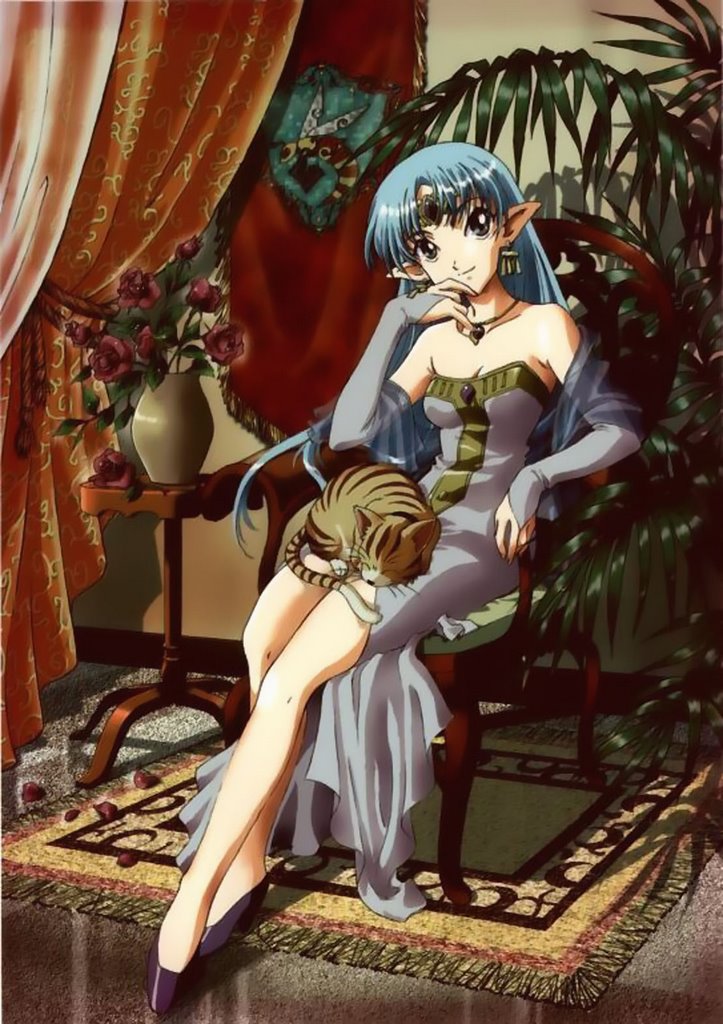
It chronicles the tale of an intergalactic empire known as Abh whom their origins used to be slave workers for early space explorers who rebel and become independent empire on their own as time goes by. Their biological construct uniqueness is an addition of another sensory organ that enabled them to feel their way around in vast space plus their biological life is extended to 200 years to sustain a long journey in harsh space. The hedonistic nature of their creators also implied when the Abhs will never age and all of them is supposedly beautiful humans with blue hair. I will leave to reader's imagination as to what the last purpose for.
The Abhs is not interested to conquer the actual planets itself, but rather they wanted exclusive control of space routes around the planets for space travelling purposes, especially the control of worm gates or called planar gates in this story.
One of the planet colonized by humans, known as Martine is Anglo based culture which recently conquered by the Imperial Abh Empire in the beginning of the story. The leader of the planet was raised into nobility much to the chagrin of the populace and his son is the next on the line, to succeed him as Duke. On the day of him joining the Abh's Star Force, he will meet a person that would forever change his life.
Lafiel, a princess from Abriel clan is a recruit on a frigate who volunteered to pick up heir to Martin dukedom, Jinto from a spaceport. She is proud, strong and can be conceited as sharp contrast to kind, accommodating and patient Jinto. Both of them started on rather interesting place on the fact that Jinto insisted to call her by her personal name which made her very happy as she interprets it as he did not regard her as a royalty to be feared but a common friend that she longs for.
This relationship will bloom further in the background of impending war between the Abh Empire and United Mankind, a group of intergalactic superpowers who is opposed to ways of Abh. The United Mankind, much quite similar to today's United Nations is conglomerate of superpowers who cherish natural human birth and disdained Abh's genetic manipulation, looking for pretext to declare war on Abh.
What make this story remarkable is author's attempt to flesh out the culture of Abh including creation of Baronh, language of the Abhs with complete writing and numerical symbolisms. The background is rich and almost limitless, thanks to adroit writing by Morioka Hiroyuki, novelist of the Seikai series.

Art
The art of the series is quite minimalist, given most of the time is just unfanciful headshots and lots of dialogue between character. However sometimes it has weird angle shots on certain torsos of the Abh, notably Lafiel which I interpret as sexual transistor scenes to relieve the boredom of long talks which occupies the onus of the series.
Background is pretty sufficient for its purpose, battles is good enough to be seen as battles. Every sprite is not wasted on fanciful things, it is just enough and it is there to fulfil the purpose of the story. Character's face is bordering on simplicity especially Lafiel, not too much for my liking but it is enough.
All in all, there is nothing exception on art department

Sound
The background music of series hinged heavily on orchestral scores and quiet background as dialogue played a major role in the anime. Some scenes need extra oomph which where this piece of effective music comes in and supplant it as those scene to rely on art alone will be bland and a bit uninspiring. Some scores is bit overused but it is not really a big issue in the 13 episode series.
The opening is evocative of grand epic atmosphere which did real justice to the vastness of space opera story in Seikai no Monshu but unfortunately the ending score is bit off, as it did not really wrap up the series in proper mood.
The OST of the series is not bad but nothing really stands out except for the opening score.
Voice acting in Japanese is very competent as usual and it is quite a joy to see Kawasumi Ayako (Saber from Fate/Stay Night 2006) playing her role as Lafiel/Lamhirh well. She alone carry the show well, complimented by expected skillful voice actings from other actors and actresses.
Presentation
The fact this anime become one of the most beloved series to many serious anime fans who truly appreciated its sheer complexity despite rather minimalist art and music department, is testimony to it's raw power of good writing, powerful script and convincing characters.
Seikai no Monshu deserves many second viewing as many nuances of story is missed during first time watching it. The story has many layers of complicated character, setting and political implications that fans will be delighted when they have revelation during second viewings.
It is not surprise that many mainstream anime fans give it a wide berth as there is no cool action or fox ninjas in the series but seasoned veteran anime fans will like it as it did not insult viewer's intelligence while presenting the material. Many things is implied and left to interpretation of viewers instead of being spoon fed in entirety. The dialogues is good and carries a big weight so much so that it is the sole difference of it from the rest of forgettable anime series in the market right now.
The stellar cast also did not disappoint as not only the voices suits the character in play, they also interesting by themselves. Seldom there is anime where side characters have received as much attention as the main characters as this one. Illuminating interactions between Admiral Spoor and Lafiel, despite it is being short and simple did illustrate many things in context of Abh culture if viewer willing to take it beyond the surface level of conversation.
This series is worthy introduction into Morioka Hiroyuki's work and it will sit on my DVD shelf as proud as the Abh themselves. Daiselle!


